
Platforms
Climate Edge
Long-term climate governance, with numbers that survive an audit.
Where to build, what to reinforce, what inaction costs — with the climate variable entering every phase of the decision, not just the report at the end.
Platforms
Climate Edge is the strategic layer of the São Tomás suite. Where Risk360 answers for the next ten days, it looks from decades out to 2100 — translating global climate scenarios into physical risk over the client’s real asset portfolio, with documented methodology and stated uncertainty.
- ~30 models
- calibrated CMIP6 ensemble
- 17 indicators
- of physical risk
- 3 horizons
- out to 2100
- IFRS S2
- TCFD · CVM · BCB · CMN · SUSEP
The engine, in three movements
1
Project · ~30 CMIP6 models
An ensemble calibrated for the territory, with a central scenario and stress scenarios.
2
Translate · 17 indicators, 3 horizons
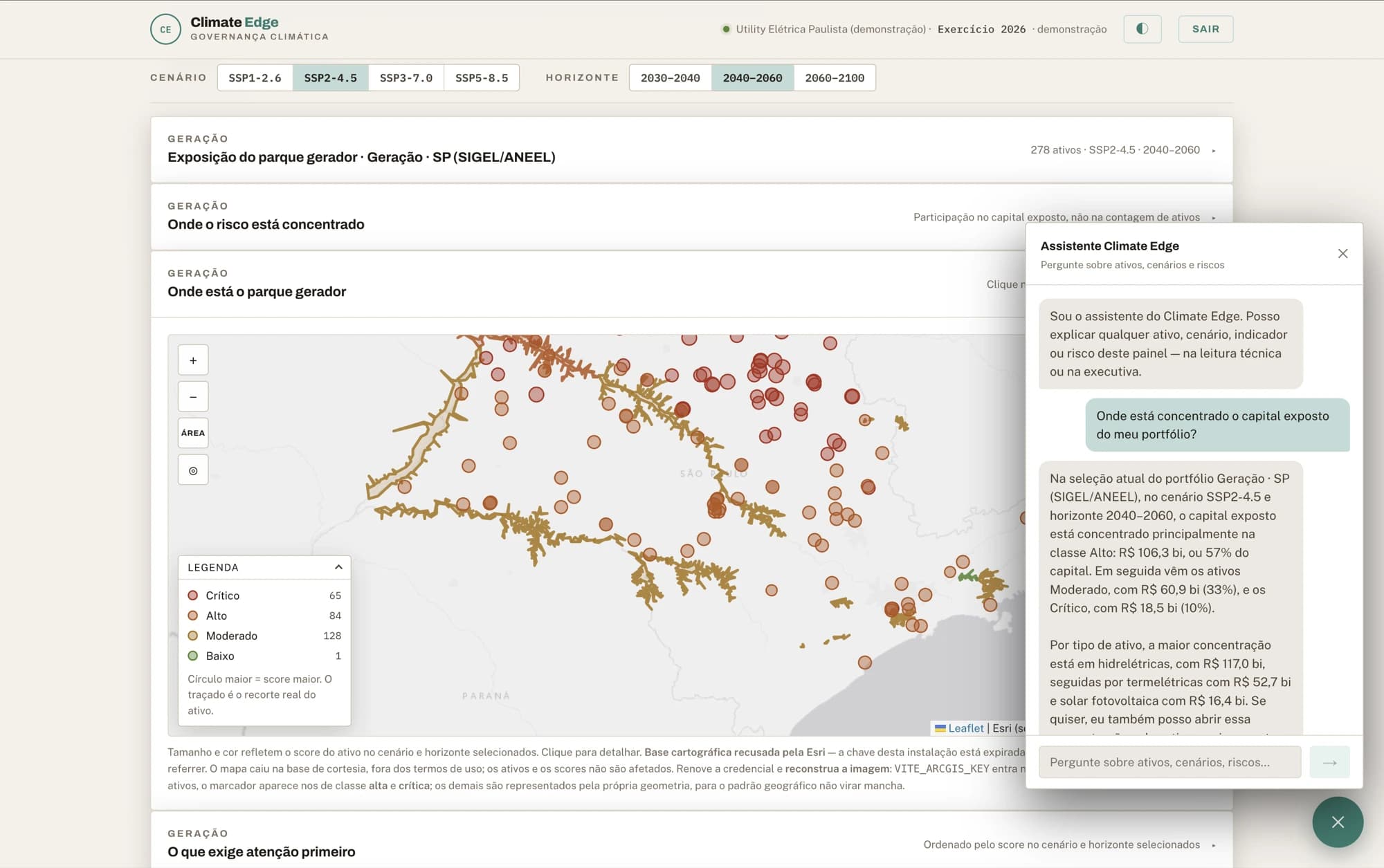
Applied to the real asset registry — not to regional averages. That is the difference between “the region warms” and “this asset warms”.
3
Support · versioned engine
Risk classification is deterministic. AI agents write the technical and executive readings and guide the decision, without ever classifying the risk. That is the architecture that survives the auditor.
Five decisions the platform supports
Where the next asset goes
A base station, a substation or a distribution centre lasts decades. Building today where climate risk will be high in ten years is a loss already signed for.
See detail
The bill arrives later, in maintenance, in insurance and in downtime. The platform compares candidate sites by dominant hazard and cost of adaptation, before capital is committed.
What to reinforce, and in what order
Prioritising resilient capex — reinforcement, drainage, redundancy, relocation — where projected risk justifies it, with the cost of inaction made explicit per asset and per horizon. Without that, adaptation becomes a wish list competing for the same budget.
Portfolios
For banks, insurers and asset managers: climate exposure of credit books, policies and real assets, at collateral granularity.
Territory
For governments: climate risk mapping as the technical basis for the adaptation, civil defence and urban planning required by law.
Disclosure
Physical risk per asset in IFRS S2 / TCFD format. It is a consequence of doing the rest well, not the reason to do it.
See detail
It is the input to the climate reporting BCB, CMN and SUSEP require from the financial sector, and that investors and clients now expect from everyone else.
The full suite
One client, two horizons: the board decides with Climate Edge; the operation acts with Risk360.
Who it is for
Risk and sustainability leadership with mandatory disclosure ahead, banks, insurers and asset managers assessing portfolio exposure, and governments needing a technical basis for adaptation plans.
The rest of the suite
Risk360
From storm nowcasting to the six-month trend: risk on every critical asset, action prioritised in the right windows, and response sustained through the crisis.
ExploreMapsAI
An AI agent over your maps: ask in Portuguese, English or Spanish, get back a map and a number — no GIS, no spreadsheet, no queue.
ExploreWeather Trends
Three horizons under one contract: the storm minute by minute, the ten days on grids down to 2 km, and the anomaly for the next six months.
ExploreWildfire Sentinel
Detection, risk and spread cross-referenced against your registry: the alarm carries the asset name, the distance in metres and an estimate of the hours until the fire reaches it.
ExploreBring us your challenge
If it involves climate, territory and data, it is our ground. The conversation starts from a real slice of your operation — not from a deck.